
Hiring a nanny for the first time? Here's what to do, in order
Start about 8 weeks before you need care. Write down your hours, duties and budget, post the job, do short phone screens, interview your favorites at home, then invite your top one or two for a paid trial day. Check references and run a background check before any offer, put everything in a written agreement, and plan an overlap week where you're home at first and step out a little more each day.
I saw a mom on Reddit this week asking where to even start with hiring her first nanny, and the replies were a pile of different opinions in no particular order. That's how most first time nanny families feel! You've never hired anyone for anything, there's no HR department, and you're about to hand your little humans to someone you met a few weeks ago.
I was the nanny for years. I sat through the interviews, the trial days and the awkward first weeks from the other side of the table, and the families who got off to a great start were the ones who laid everything out clearly from day one. Here's the order I'd do it in.
How far ahead should I start looking for a nanny?
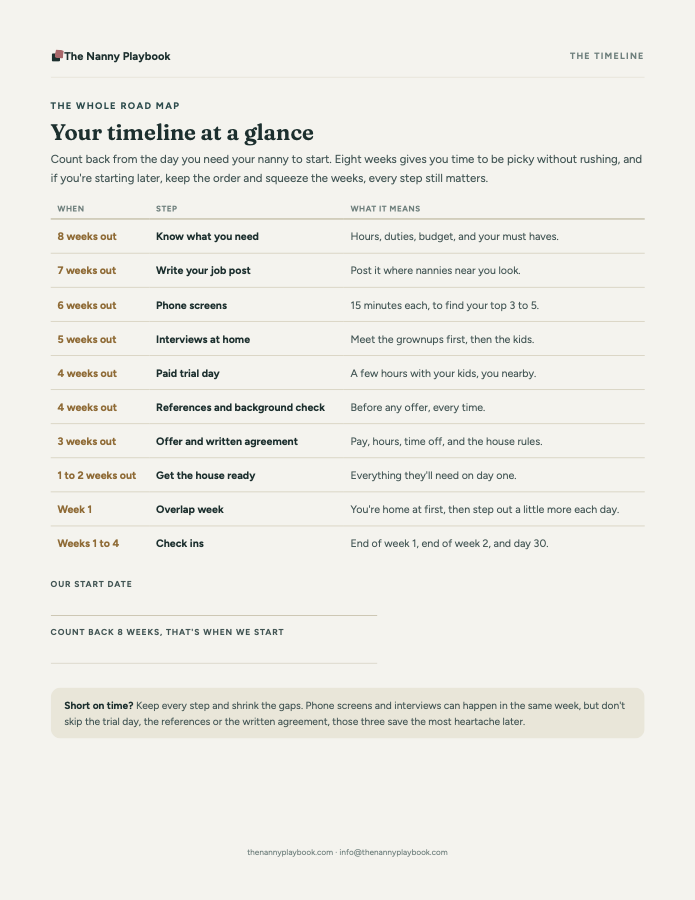
About 8 weeks before your start date. That gives you time to be picky without rushing, and room for a trial day, references and a background check before anyone starts. If you have less time, keep the same order and squeeze the weeks, every step still matters.
- 8 weeks out: know what you need
- 7 weeks out: write and post the job
- 6 weeks out: 15 minute phone screens
- 5 weeks out: interviews at your home
- 4 weeks out: paid trial day, references and a background check
- 3 weeks out: the offer and a written agreement
- 1 to 2 weeks out: get the house ready
- Week 1: the overlap week, then check ins at week 1, week 2 and day 30
What should I figure out before I post the job?
Four things: the exact hours, the jobs (just childcare, or also kid laundry, meals, driving, homework), your budget, and your must haves versus nice to haves. Pay varies a lot by city, and in bigger cities it can run $33 to $50 an hour (Care.com), so look up rates near you and leave room for taxes and paid time off on top.
What goes in a good nanny job post?
Keep it short and clear: your neighborhood, the kids' ages, the hours, the start date, the pay range, that you'll pay on the books, a peek at a normal day, and how to apply. From the nanny side, a post with the pay listed is one we answered first, and "on the books" told us the family would handle payroll the right way.
What do I ask in the phone screen?
This call is only to see if it's worth meeting, so keep it to 15 minutes and ask everyone the same questions:
- Can you work these hours, starting on this date?
- Does this pay range work for you?
- Tell me about the families you've worked with. How old were the kids, and how long did you stay?
- What made you leave your last job?
- Are you CPR and first aid certified, or willing to get certified?
- What are you hoping to find in your next family?
Good signs: they stayed with families a year or more, talk about past kids by name, and ask you questions back.
How should the in person interview go?
Plan about an hour at your home. Talk grownup to grownup first, then bring the kids in for the last 15 minutes and watch more than you talk. Does the nanny get down on their level? Do they talk to your kids, or just about them? Scenario questions tell you the most, like "What would you do if my toddler had a meltdown because it's time to leave the park?" or "What would you do if you disagreed with how I handle something?"
And be ready to be interviewed back. Good nannies will ask about guaranteed hours, sick days, raises and what happens when you're home. Having your answers ready is a big green flag for them!
When should the nanny's first visit with my kids be?
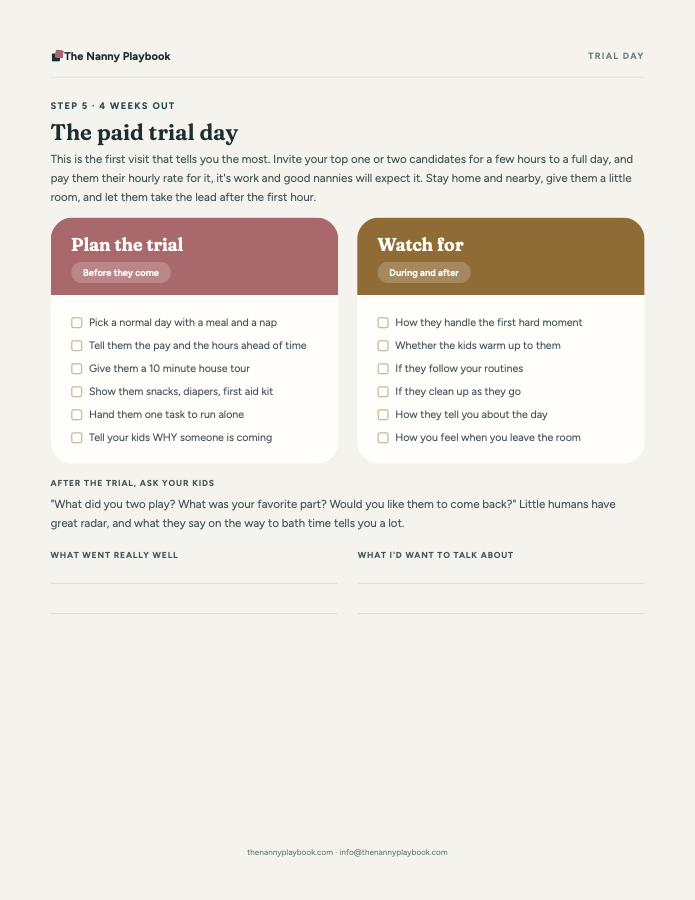
The short meet at the end of the interview is the first hello. The first visit that tells you the most is a paid trial day with your top one or two candidates, about 4 weeks before the start date. Pick a normal day with a meal and a nap or quiet time in it, pay their hourly rate, stay home and nearby, and hand them one thing to run on their own, like lunch or the park.
Watch how they handle the first hard moment, whether they follow your routines without reminders, and how they tell you about the day at the end. Then ask your kids on the way to bath time, "What did you two play? Would you like them to come back?" Little humans have great radar, and what they say tells you a lot.
Do I need references and a background check?
Yes, before any offer. Call at least two recent families and ask what a normal day was like, about a time something went wrong, why the job ended, and "Would you hire them again?" Listen for a quick, warm yes. Run a background check with the nanny's written permission, most families use an agency or a background check service for this.
What goes in a nanny agreement?
A written agreement is where most future misunderstandings get solved before they start. Cover the hourly rate and pay day, guaranteed weekly hours, overtime, paid time off, holidays, sick days, what happens when you travel, late pick up, mileage, phone and social media rules, photos of the kids online, the main jobs, a first review date, and how much notice either of you gives. Sign it together and each keep a copy.
A quick word on taxes, since it surprises a lot of first time families: a nanny in your home is usually your household employee, so once you pay more than the IRS yearly threshold you handle payroll taxes and a W2 (IRS Publication 926). Live out nannies are also generally owed overtime past 40 hours a week (U.S. Department of Labor). Many families use a nanny payroll service so it's handled for them. This isn't legal or tax advice, so check your state's rules too.
What should I have ready for the nanny's first day?
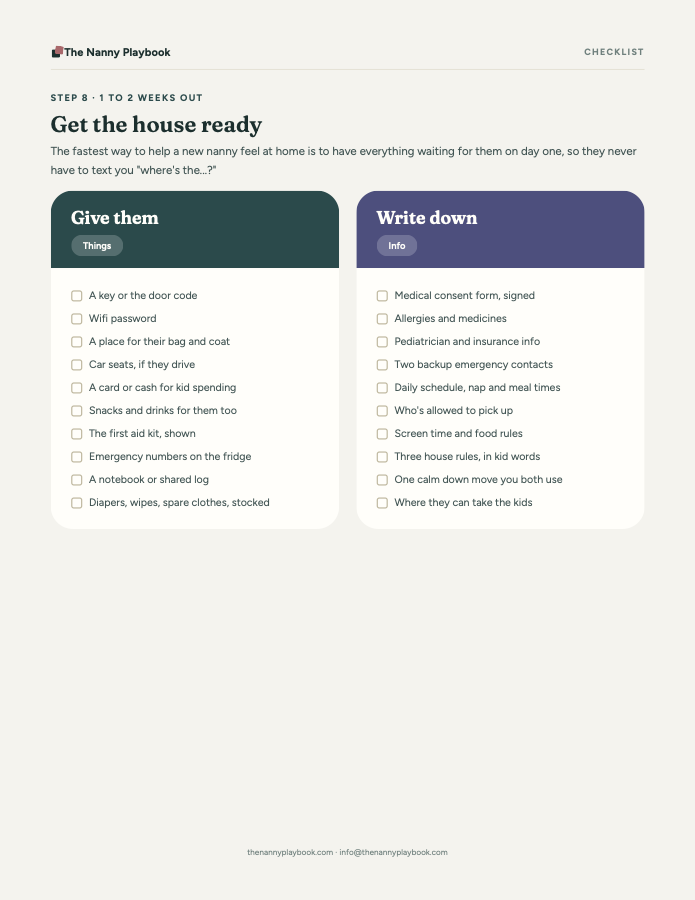
Everything they'd otherwise have to text you about:
- A key or door code, the wifi password, and a spot for their bag
- Car seats if they drive, and a card or cash for kid spending
- A signed medical consent form, allergies, medicines, and the pediatrician's number
- Two backup emergency contacts and who's allowed to pick up
- The daily schedule, with nap and meal times
- Screen time and food rules, plus three house rules in kid words (here's how to write them)
- One calm down move you both use, like belly breathing
- A notebook or shared log for the day
How should the first week go?
Plan an overlap week, and pay for it, they're learning your family and that's work. Day 1 you're home all day and they shadow you. Day 2 you're home in another room while they lead. Day 3 you step out for a few hours. Day 4 is half a day. Day 5 is a full day on their own, with a ten minute chat at the end.
Tell your kids why someone new is coming before day one, little humans like to know WHY just as much as we do:
Expect a few tears at the first goodbyes, that's totally normal! A short, cheerful goodbye that's the same every time helps more than sneaking out. Then set check ins for the end of week 1, week 2 and day 30, so feedback feels normal from the start (more on giving feedback here).
Peek inside the printable guide
I put all of this into a 15 page guide you can print and write on, so the whole hire lives in one folder: the timeline, every question list, the trial day plan, the agreement checklist, the day one checklist, an All About Me sheet for your kids to fill in, the overlap week plan and a daily log.
Get your copy below, it opens right after you sign up.
Quick questions
How long does it take to hire a nanny?
Plan on about 8 weeks from writing down what you need to the nanny's first day. That leaves time for phone screens, interviews, a paid trial day, references, a background check and a written agreement.
Should I pay a nanny for a trial day?
Yes. A trial day is work, so pay the candidate's hourly rate for the hours they spend with your kids. Good nannies expect it, and it starts the relationship on the right foot.
What should I give my nanny on the first day?
A key or door code, wifi password, emergency contacts, a signed medical consent form, allergies and medicines, the daily schedule, house rules, car seats if they drive, and a card or cash for kid spending.
Do I have to pay taxes for my nanny?
In the U.S., a nanny who works in your home is usually a household employee, so once you pay more than the IRS yearly threshold you're responsible for payroll taxes and a W2. IRS Publication 926 has the current numbers, and many families use a nanny payroll service.